Editorial Team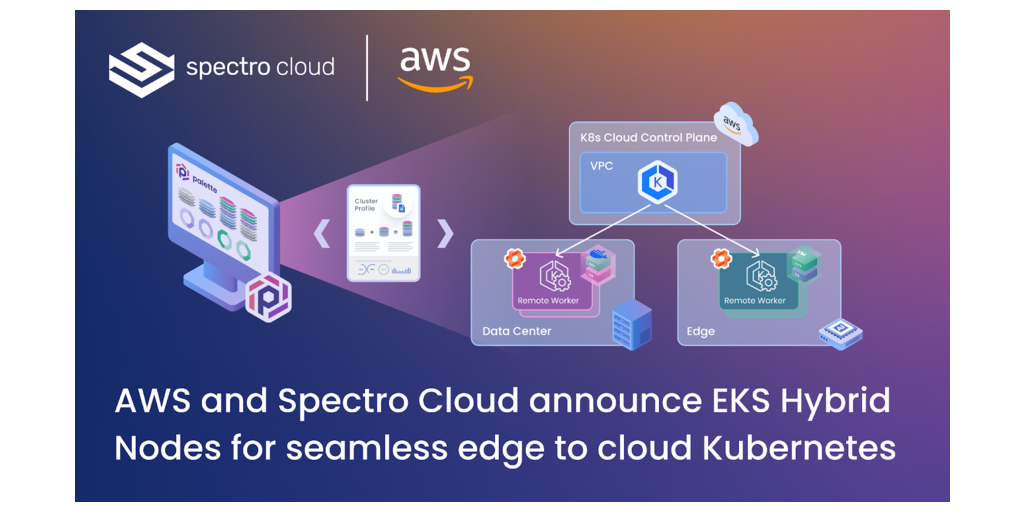
Spectro Cloud has announced its role as a launch partner for the Amazon EKS Hybrid Nodes feature, unveiled at AWS re:Invent 2024. This new capability extends the functionality of Amazon’s Elastic Kubernetes Service (EKS), bridging the gap between cloud and edge computing environments.
For developers working with distributed systems, the EKS Hybrid Nodes offer significant advantages. This feature allows Kubernetes clusters to span both on-premise resources and the cloud, addressing a common challenge in modern application architectures: managing infrastructure across diverse environments.
By leveraging EKS Hybrid Nodes, developers can deploy applications closer to end-users, improving latency and performance for edge applications. For instance, consider a scenario where a retail company needs to process transactions at the edge to optimize customer experiences. With hybrid nodes, they can run Kubernetes workloads on local servers while maintaining direct integration with their cloud-based services, facilitating real-time data processing.
This hybrid model not only enhances performance but also strengthens resilience and reliability. Should connectivity issues arise with the cloud, on-premise clusters can remain operational, providing failover capabilities that are crucial for mission-critical applications.
Furthermore, the integration of EKS with Spectro Cloud’s platform enhances operational efficiency. Developers can utilize Spectro Cloud’s advanced management tools to automate deployments, scaling, and governance of hybrid environments, thus streamlining workflows and reducing operational overhead.
As we look to the future, the trend towards hybrid and multi-cloud architectures is likely to accelerate. The increasing demand for low-latency applications, coupled with the need for real-time data analysis, means developers will need to adapt their skills and strategies to harness these new capabilities. The ability to manage Kubernetes seamlessly across both cloud and edge will enable faster innovation cycles and more responsive application development.
For those keen on diving deeper into this feature, the official AWS documentation provides comprehensive guidance on setting up and managing EKS Hybrid Nodes. Developers can explore practical examples, best practices, and architectural considerations that will enhance their understanding and application of this technology.
In summary, as the landscape of application development continues to evolve, tools like EKS Hybrid Nodes will be pivotal in enabling developers to build and scale applications seamlessly across diverse environments, paving the way for innovation and improved end-user experiences.